
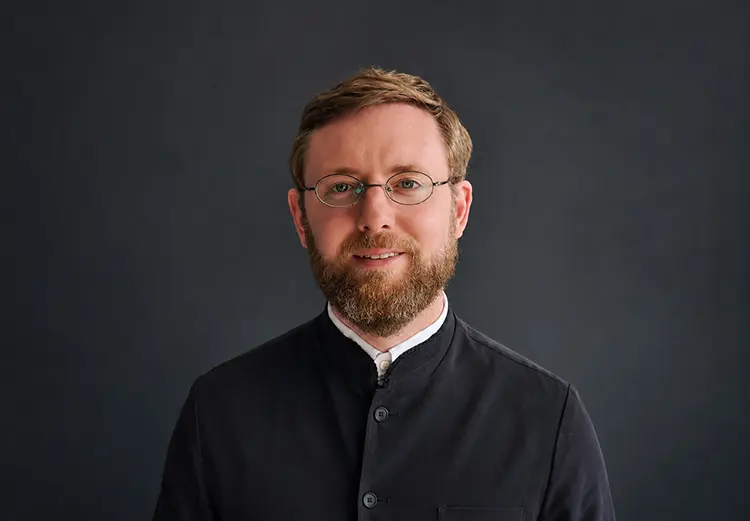
On Wednesday, May 20, 2026, the Department of Theology at the National and Kapodistrian University of Athens hosted the annual John Zizioulas Lecture.
This year’s speaker was Alexis Torrance, whose lecture, The Gift of Reason and the Future of Orthodox Theology, presented material from his forthcoming Oxford University Press monograph Recovering the Craft of Orthodox Theology: Understanding Seeking Union. Representatives of the Ecumenical Patriarchate and the Church of Greece were present, and a discussion in both Greek and English followed the lecture.
Fr. Torrance opened with a personal recollection. As a teenager, before reading a single page of John Zizioulas, he attended a Divine Liturgy celebrated by the Metropolitan at the Stavropegial Monastery of St. John the Baptist. “His whole being went into the Liturgy,” Torrance recalled. “He entered the Kingdom of Heaven, but by the power of his prayer he brought us all along with him.” That encounter shaped everything that followed. Metropolitan John’s theology was never, for him, merely a system of propositions to be debated, but something first encountered as embodied ecclesial reality. The lecture itself thus became, in part, a tribute to that example—an effort not simply to repeat Zizioulas, but to continue taking seriously the same theological vocation.
Torrance’s central argument concerned what he described as a contemporary crisis in Orthodox theology, especially in the West: the gradual erosion of confidence in the intellect as a legitimate instrument of theological inquiry. According to Torrance, two tendencies have contributed to this development. The first is the elevation of apophaticism—the patristic insistence on the ineffability of God—into a generalized suspicion toward theological discourse itself. The second is the deployment of “theology-as-prayer” polemically against “theology-as-discipline.” Both tendencies, he argued, emerge from authentic patristic sources, yet when pushed beyond their proper limits they risk collapsing into obscurantism.
The figure most associated with this position, according to Torrance, was John Romanides. Romanides described authentic Orthodox theology as “authoritatively experiential” and “clearly non-speculative,” reserving the title of theologian primarily for spiritual elders possessing direct experiential knowledge of God. He also proposed a sharp anthropological distinction between the nous —the spiritual faculty darkened by the Fall—and the rational faculty, which he considered essentially untouched and therefore external to genuine theological activity. Torrance challenged both claims, especially the anthropological distinction, arguing that they lack sufficient grounding in the broader patristic tradition.
To support his argument, Torrance turned to patristic sources that are neither marginal nor obscure. Nemesius of Emesa, in On the Nature of Man —a text later received almost unchanged by both Maximus the Confessor and John of Damascus—explicitly rejects the notion that the nous constitutes a separate faculty within the human being. Rather, Nemesius situates it within the rational faculty itself, as its contemplative dimension, distinguishable from practical reason but not separable from it. Romanides’ portrayal of a non-rational nous, recoverable exclusively through prayer, finds little support in this tradition. Torrance further cited Basil the Great, who describes the nous as “ever-moving” ( aei-kinētos )—not inert, and certainly not detached from cognition.
The lecture’s most detailed patristic analysis focused on Ad Thalassium 59 of Maximus the Confessor. Interpreting the prophets’ “searching and investigating” into salvation, Maximus distinguishes four cognitive movements—seeking, inquiry, research, and investigation—which he assigns variously to intellect and reason before explicitly “transposing” them into divine things. For Maximus, Torrance argued, rational inquiry is not abolished in theology but purified and redirected. Theological cognition must indeed be joined to ascetic struggle, virtue, and desire for God. Yet the ascetic dimension does not replace rationality; it constitutes the condition for its proper operation.
A similar synthesis appears, Torrance noted, in the work of John of Damascus. His Dialectica, the philosophical introduction to the Fountain of Knowledge trilogy, functions partly as a curriculum for theological formation, training the mind to think clearly and argue carefully before approaching doctrine itself. John compares the theologian to a craftsman whose tools include reason and rhetoric: they are servants rather than masters, but nonetheless necessary instruments. Torrance highlighted John’s defense of a measured form of “sophistry” in the service of truth when confronting intellectually serious opponents. Such a position, he argued, does not represent capitulation to rationalism, but recognition that the Church must remain capable of giving a coherent account of its faith.
Torrance concluded by turning to the present moment. Between Lazarus Saturday and Holy Saturday in 2026, an estimated 18,000 catechumens were reportedly received into the Orthodox Church in the United States within a single week. The Church, he argued, is no longer merely preparing for growth; it is already experiencing it. The principal deficit is therefore not only one of clergy or parish infrastructure, but of theological formation itself. A Church that treats serious theology as a suspicious Western intrusion will not shield converts from poor theology; rather, it will leave them vulnerable to constructing their own. The answer, Torrance proposed, is not to abandon the contemplative and experiential dimensions of theology, but to recognize rational inquiry as properly ordered toward them. He suggested the phrase intellectus quaerens unionem —“understanding seeking union”—as expressing the full trajectory of theology: faith seeking understanding, and understanding seeking communion with God. He concluded with an appeal for the renewal of Halki Seminary as a concrete institutional embodiment of that vision.