
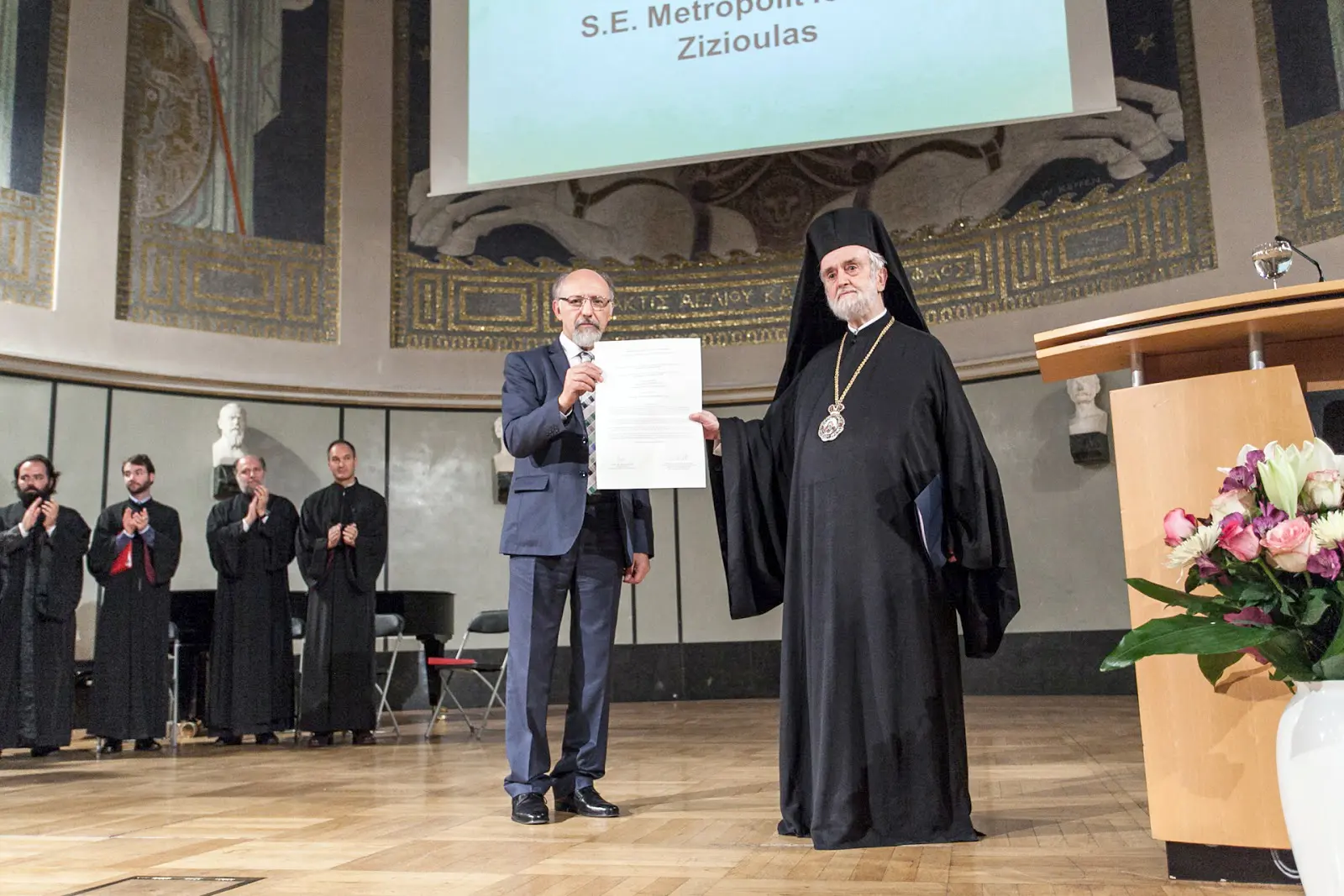
On the Occasion of the Conferral of an Honorary Doctorate (Dr. h.c.) to Prof. Dr. Ioannis Zizioulas, July 2, 2010
Laudatio Prof. Dr. Thomas Bremer anl. der Verleihung des Dr. h. c. an Herrn Prof. Dr. loannis Zizioulas am 2. Juli 2010
Here’s the English translation of the laudation speech:
[Address,]
A few years ago, I participated in a theological conference in a remote Serbian provincial town with just 40,000 inhabitants. The local Orthodox bishop, who was also a professor at the Faculty of Theology in Belgrade and knew me, invited me to a gathering on the theme “Ontology and Ethics.” I expected a modest conference with a few dozen theologians and was greatly surprised to learn that the event would take place in the large hall of the local cultural center, which seated over 500 people. My surprise grew even more when I arrived and saw the hall completely packed, with many attendees unable to find a seat.
The reason was clear: the keynote speaker was none other than the Metropolitan of Pergamon and renowned Orthodox theologian Ioannis Zizioulas, whom we are honored to welcome here today. As he began his lecture in Greek, translated consecutively into Serbian, he quickly captivated the audience. One could witness the remarkable phenomenon of hundreds of listeners seated in silent attentiveness, hanging on his every word.
Who is this man, whose calm and measured manner of speaking so deeply moved even an audience in provincial Serbia? Allow me to introduce the future honorary doctor of our faculty—first through his biography, then through his theological contributions and ecclesiastical engagement.
Ioannis Zizioulas was born in 1931 in the mountain village of Katafigio in northern Greece. He studied theology at the two main theological faculties in the country—first in Thessaloniki, then in Athens. After graduating in 1955, he continued his studies abroad, beginning with a six-month advanced course at the Ecumenical Institute of the World Council of Churches in Bossey (Switzerland), which left a lasting impact on his ecumenical interests.
Zizioulas then studied at Harvard University, taking systematic theology with Paul Tillich and church history with the renowned Orthodox historian Georges Florovsky. Florovsky, whose central theme was the liberation of Orthodox theology from Western influences and its return to the patristic tradition—a movement known as the “neo-patristic synthesis”—profoundly shaped the young Zizioulas. He earned his master’s degree at Harvard and continued his academic development from 1959 as a Resident Fellow at Dumbarton Oaks in Washington, preparing his doctoral dissertation.
During this time, he also taught at the two most distinguished Orthodox academic institutions in the U.S.— Holy Cross School of Theology in Boston and St. Vladimir’s Seminary in New York. At St. Vladimir’s, he encountered the leading figures of Russian émigré theology and was introduced to the thought of Nikolai Afanasiev, a foundational figure in Russian eucharistic ecclesiology.
Returning to Greece, Zizioulas became an assistant in church history at the University of Athens and earned his doctorate in 1966 with a dissertation titled “The Unity of the Church in the Holy Eucharist and the Bishop during the First Three Centuries”, developed over eight years in the United States. Although historical in focus, this dissertation would have profound implications for systematic theology.
After a brief period in Athens, Zizioulas moved to Geneva, working from 1967 to 1970 in the secretariat of the Faith and Order Commission of the World Council of Churches (WCC). He later accepted a position at the University of Edinburgh, teaching Patristics, and three years later was appointed Professor of Dogmatic Theology at the University of Glasgow, where he served from 1973 to 1987.
During those fourteen years, Prof. Zizioulas gained international recognition as a leading systematic theologian and a committed ecumenist. He served on the Faith and Order Commission from 1977 to 1988, and from 1979 to 1987 was a member of the Central Committee of the WCC, its main governing body. In 1980, he became a member of the Joint Commission for Theological Dialogue between the Orthodox and Roman Catholic Churches, later serving as Orthodox Co-Chair alongside Cardinal Kasper from 2005 onward.
Between 1988 and 2005, he also served as Co-Chair of the Orthodox–Anglican Dialogue Commission.
During his time in Glasgow, Zizioulas was a visiting professor at several institutions, including King’s College London, his alma mater in Thessaloniki, the Gregorian University, and the University of Geneva.
In 1986, he was appointed Metropolitan of Pergamon, a titular see of the Ecumenical Patriarchate of Constantinople. Within days, he received monastic tonsure (a prerequisite for the episcopacy in Orthodox tradition), was ordained deacon, priest, and bishop, and was consecrated on June 22, 1986.
He became a member of the Holy Synod of the Ecumenical Patriarchate in 2006–2007 and currently leads the Patriarchate’s representation office in Athens.
Metropolitan Ioannis has received many academic honors. Since 1993 he has been a full member of the Academy of Sciences in Athens, serving as its President in 2002. He is also a member of the Académie Internationale des Sciences Religieuses in Brussels and has been awarded honorary doctorates from the Institut Catholique de Paris (1990), the Orthodox Faculty in Belgrade, the Institut de Théologie Orthodoxe Saint-Serge in Paris, and the University of Cluj-Napoca in Romania.
Let us now turn to the theological contributions of our honoree.
He is the author of nine books and over 100 articles, many translated into languages including Arabic and Chinese. Since 1988, more than 25 dissertations have been written on his theology—in Britain, the U.S., at the Sorbonne, the Gregorian University, in Canada, and even Heidelberg, where a second is currently underway. A growing body of scholarly literature continues to engage with his thought.
Two areas stand out in his systematic theology: ecclesiology and anthropology.
His groundbreaking dissertation explored the unity of the Church in the context of the Eucharist and the office of the bishop, establishing two key principles:
- The Church arises from the Eucharist. Wherever the Eucharist is celebrated, the Church is fully present in her catholicity. This affirms the local church as the real Church of Christ—not merely a subdivision of a greater whole. This Eucharistic ecclesiology has significant ecumenical implications.
- The Eucharistic community exists as a structured body, centered on the bishop ( episkopos ) who presides within the community. His primary role is not administrative, but liturgical —as the celebrant of the Eucharist and the visible sign of unity.
This vision entails a radical shift in ecclesiological thinking. The unity of the universal Church is expressed not through institutional centralization, but through communion (koinonia) among local churches united by their bishops. This gives rise to a synodal model of governance, where primacy is exercised not by individuals but by churches in communion. In Orthodox theology, this role of primacy has traditionally been ascribed to the Church of Rome, opening new paths for ecumenical dialogue.
In his theological anthropology, Zizioulas builds on the patristic tradition, placing central emphasis on the term “personhood” —a word difficult to translate, more than just “personality” or “individual existence.” For Zizioulas, personhood is realized only in communion, in freely chosen relationships, especially in participation in the Trinitarian life of God through the Church.
This anthropology is deeply eschatological: through Baptism, the human being receives a new ontological freedom that death cannot limit. His famous book Being As Communion gathers these insights into a vision of the human person and the Church united in freedom, communion, and liturgical life.
Metropolitan Ioannis’ theology is not an abstract system—it arises from his liturgical experience, which gives his thought unique authenticity.
He has spent much of his life in non-Orthodox contexts, engaging respectfully and creatively with other traditions, always grounded in the Orthodox Fathers. His contribution to the neo-patristic synthesis and his role in the Ravenna document (2007) —a landmark in Catholic-Orthodox dialogue—show his impact on redefining theological ecumenism.
His significance lies not only in his theological achievements but also in his ecclesial witness. He consistently champions dialogue and unity, even when facing criticism. In a recent interview, he boldly said:
History is guided by God. Those who say unity between Churches is impossible are placing themselves in God’s position. Who are we to determine the future? We are called to work tirelessly for unity. If we fail to do so—or do it at the cost of our Fathers’ faith—we will answer before God. The outcome is in His hands. He will find a way to fulfill His will that we may all be one.
These are clear words for all who question the value of ecumenical work.
Let me close by returning to the Serbian conference I mentioned earlier. On the Sunday following his lecture, Metropolitan Ioannis celebrated the Divine Liturgy with the local bishop. The cathedral, like the lecture hall, was filled to capacity. Yet the atmosphere was different. The bishop presided not as a distant figure, but as part of the community — serving and celebrating. Metropolitan Ioannis lives what he teaches. His theology is born from worship, and this makes it compelling.
The Catholic Faculty of Theology at our university is privileged to honor such a profound theologian, committed ecumenist, and deeply rooted bishop of the Church of Christ.
Εἰς πολλὰ ἔτη, Σεβασμιώτατε!
(Many years to you, Your Eminence!)