
World Council of Churches & Volos Academy for Theological Studies, 2026
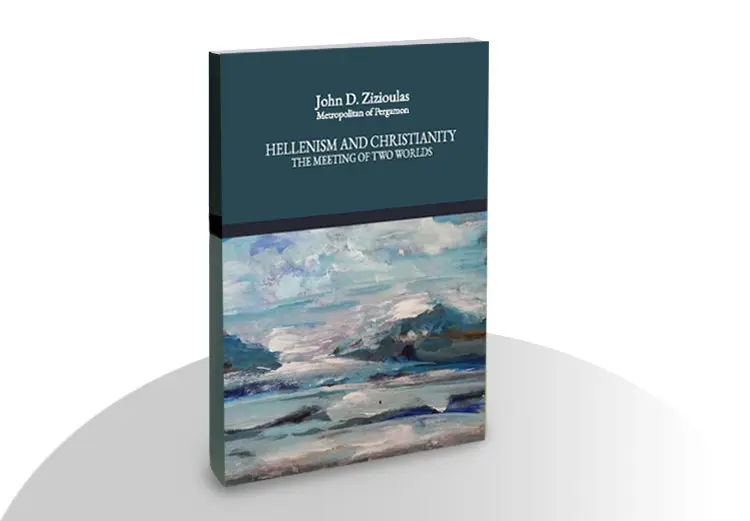
In 2026, the World Council of Churches, in collaboration with the Volos Academy for Theological Studies, released a new English translation of Hellenism and Christianity—The Meeting of Two Worlds, one of the most important historical-theological studies by Metropolitan John Zizioulas of Pergamon. The volume has been translated by Fr. Gregory Edwards and edited by Dr. Nikolaos Asproulis. The very fact that the World Council of Churches has undertaken the publication of this study by John Zizioulas speaks volumes. It reflects not only the enduring appreciation of the book within global Christianity but also the recognized and lasting contribution of Metropolitan John to the wider Christian world.
Originally published in Greek in 1976 as part of a broader series on the history of the Greek people, the book marks a decisive stage in John Zizioulas’reflection on the encounter between the Gospel and the Greek intellectual tradition. Addressing the famous question—“What has Athens to do with Jerusalem?”—Metropolitan John moves beyond simplistic narratives of conflict or absorption. Instead, he presents the meeting of Hellenism and Christianity as a dramatic and creative process that decisively shaped the theological consciousness of the early Church.
Focusing especially on the first three centuries, Zizioulas situates Christianity within its Jewish roots while carefully tracing its engagement with Greek philosophy and culture. Figures such as Ignatius of Antioch and Irenaeus of Lyon illustrate how the Fathers responded critically to the strengths and weaknesses of Hellenistic thought. For the Metropolitan, this engagement was neither capitulation nor rejection, but transformation. Greek ontological categories were reinterpreted in light of the ecclesial experience of the Triune God—an experience grounded not in abstraction but in the eucharistic life of the community.
One of the central insights of the study is that this encounter altered both worlds. Christianity did not merely adopt Greek concepts; it reshaped them. Being itself came to be understood in terms of freedom, communion, and personal relationship. At the same time, Hellenism was neither erased nor eclipsed but renewed through its encounter with revelation. The declaration of the Apostle Paul—“there is neither Greek nor Jew”—became, through the work of the Greek Fathers, a historical and ontological reality.
The book has long been praised for its clarity and intellectual sobriety. Commentators have noted John Zizioulas’ rare simplicity of expression and his ability to approach history theologically and theology historically—an approach that, at the time of its publication, was far from self-evident.
Nearly five decades after its first appearance, Hellenism and Christianity remains strikingly relevant. It offers not only a historical analysis but also a contemporary challenge: that the Church today must engage prevailing culture with depth, discernment, and creativity—critically assessing it, entering into dialogue with it, and offering an alternative rooted in the living tradition of the Fathers.
The 2026 English edition now makes this seminal work accessible to a broader international readership and invites a new generation to reflect on the enduring significance of the meeting between Athens and Jerusalem.